The Last Mile Litmus: How Catering Services Are Testing the Limits of Logistics and Customer Trust

The modern catering industry is no longer defined by the quality of its cuisine alone. The battleground has shifted to the last mile—a high-stakes gauntlet where logistics, timing, and customer perception collide. For food service businesses, this final stretch is where reputations are forged or fractured, where the promise of a seamless experience either delivers or dissolves. The challenge is no longer just about getting food from point A to point B; it’s about doing so in a way that feels effortless, reliable, and even luxurious to the end consumer. This is the last mile litmus test, and few industries face its scrutiny as intensely as catering.
The Illusion of Simplicity
To the customer, ordering catering—whether for a corporate event, a private gathering, or a last-minute meal delivery—appears deceptively simple. A few taps on an app, a confirmation email, and the expectation is set: the food will arrive on time, at the right temperature, and in pristine condition. Yet behind this facade of simplicity lies a labyrinth of variables. Traffic patterns, weather conditions, kitchen bottlenecks, and even the unpredictability of human behavior (both on the delivery and receiving ends) conspire to disrupt the illusion. The catering business that masters this complexity doesn’t just survive; it thrives by turning logistical hurdles into competitive advantages.
Take, for example, the rise of drop-off catering services. Unlike traditional event catering, where staff are present to serve and manage the experience, drop-off catering relies entirely on the precision of the handoff. The food must be packaged not just to preserve quality but to communicate care—insulated containers that maintain temperature, tamper-evident seals that assure safety, and clear labeling that eliminates guesswork. Every detail is a silent ambassador of the brand, and in the absence of a human touch, these elements must speak volumes. The best catering services understand this and treat packaging as an extension of their customer service, not an afterthought.
The On-Demand Paradox
The proliferation of on-demand services has conditioned customers to expect immediacy, but catering operates on a different rhythm. Unlike a single meal delivery, where a 30-minute delay might be forgiven, catering orders often serve dozens—or hundreds—of people, where timing is non-negotiable. A delayed delivery to a corporate lunch can derail an entire meeting schedule; a late arrival for a wedding reception is a logistical nightmare. Yet, the same customers who demand punctuality also crave flexibility. They want to place last-minute orders, modify quantities on the fly, and track deliveries in real time. This paradox—between the rigidity of timing and the fluidity of demand—is where many catering businesses stumble.
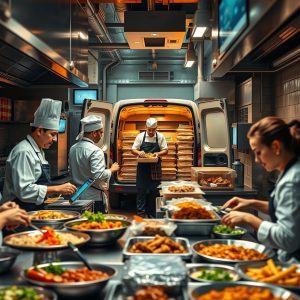
Cloud kitchens and ghost kitchens have emerged as a partial solution, allowing catering services to centralize production and streamline operations. By decoupling the kitchen from the retail space, these businesses can optimize for volume, reduce overhead, and respond more nimbly to fluctuating demand. However, this model introduces its own challenges. Without a physical storefront, the brand’s reputation hinges entirely on the quality of its deliveries. A single mishap—a cold dish, a missing item, a late arrival—can erode trust in ways that are difficult to recover from. For cloud kitchens, the last mile isn’t just a logistical challenge; it’s an existential one.
The Human Factor in a Digital World
Technology has revolutionized the catering industry, from online ordering platforms to AI-driven demand forecasting. Yet, for all its efficiencies, technology cannot fully replace the human element that defines exceptional service. The best catering businesses recognize this and use technology as a tool to enhance—not replace—human interaction. A well-timed text message from a delivery driver, a follow-up call to ensure satisfaction, or a handwritten note included with an order can transform a transaction into a relationship. These small gestures are the difference between a one-time customer and a loyal advocate.
Customer service excellence in catering is not about grand gestures; it’s about consistency. It’s the assurance that every order, whether for a single meal or a 200-person event, will be handled with the same level of care. It’s the ability to anticipate problems before they arise—like proactively rerouting a delivery to avoid traffic or including extra utensils when an order is placed for a large group. These details may seem minor, but they are the building blocks of trust. In an industry where the product is perishable and the stakes are high, trust is the ultimate currency.
The Logistics of Perception
The last mile is not just a physical journey; it’s a psychological one. The moment a customer interacts with a delivery—whether it’s a corporate lunch arriving at an office or a family meal dropped off at home—they are subconsciously evaluating the entire experience. Was the food still warm? Were the portions accurate? Did the driver arrive on time? Was the packaging intact? These questions are answered in seconds, but their impact lingers. A positive experience reinforces the decision to order again; a negative one plants seeds of doubt that can be difficult to uproot.
For catering businesses, this means that logistics must be designed with perception in mind. It’s not enough for the food to arrive on time; it must arrive in a way that feels intentional. This could mean using branded packaging that doubles as serving ware, or providing clear instructions for reheating and plating. It could mean offering a range of delivery windows to accommodate different schedules, or providing real-time tracking so customers feel informed and in control. The goal is to make the customer feel like the delivery was tailored specifically for them, even if it’s one of hundreds that day.
The Small Business Advantage
While large catering chains and cloud kitchens benefit from scale, small businesses often have the upper hand when it comes to agility and personalization. A local catering service can offer hyper-local delivery routes, reducing transit times and improving freshness. They can build relationships with clients, remembering preferences and anticipating needs. They can pivot quickly, adapting to last-minute changes or custom requests in ways that larger operations might struggle with. In the last mile, where every second counts, this flexibility can be a game-changer.
However, small businesses must also contend with the limitations of their size. Without the infrastructure of a larger operation, they may struggle with consistency, especially during peak demand. This is where strategic partnerships come into play. Collaborating with local logistics providers, leveraging third-party delivery platforms, or even sharing resources with other small businesses can help level the playing field. The key is to turn limitations into opportunities—like offering a premium delivery service for local clients or specializing in niche markets, such as vegan or gluten-free catering, where demand outpaces supply.
The catering industry is undergoing a silent revolution, one where the last mile is no longer an afterthought but the defining factor of success. Businesses that treat delivery as an extension of their brand—rather than a logistical necessity—will set themselves apart in an increasingly crowded market. The challenge is not just to move food from point A to point B, but to do so in a way that leaves customers feeling valued, satisfied, and eager to return. In this high-stakes environment, the businesses that thrive will be those that understand the last mile is not just a distance to be covered, but a promise to be kept.