The Last Mile Liturgy: How Customer Service Excellence Becomes the Unseen Backbone of Catering Dominance
The modern catering industry is no longer defined solely by the quality of its cuisine. In an era where on-demand services, express delivery, and cloud kitchens have democratized access to gourmet experiences, the true differentiator lies in the unseen infrastructure that ensures a meal arrives not just on time, but with the precision of a surgical strike. The battleground has shifted from the kitchen to the last mile—a space where customer service excellence is not an afterthought but the very foundation upon which catering empires are built.
The Illusion of Seamlessness
Consumers today expect more than food; they demand an experience that feels effortless, almost magical. The rise of online catering orders and drop-off catering services has conditioned them to believe that logistics should be invisible. Yet behind every frictionless delivery is a labyrinth of decisions: route optimization algorithms, real-time temperature monitoring, and contingency plans for traffic snarls or last-minute dietary adjustments. The illusion of seamlessness is maintained only when customer service operates as the central nervous system of the operation, translating data into human-centric solutions.
Consider the corporate catering sector, where a delayed or mismanaged order can derail an entire meeting. The stakes are higher than mere inconvenience; they extend to reputational damage and lost trust. Here, the role of customer service transcends problem-solving. It becomes a proactive force, anticipating needs before they arise—whether that means preemptively adjusting portion sizes for an unexpectedly large group or ensuring a vegan option is not an afterthought but a centerpiece. The best catering services don’t just react; they predict, adapt, and execute with the precision of a Swiss watch.
The Human Element in a Digital Age
For all the advancements in logistics technology, the human touch remains irreplaceable. Automated confirmations and AI-driven chatbots can handle routine inquiries, but they falter when faced with the unpredictable: a client who changes their mind at the eleventh hour, a delivery address that materializes as a construction site, or a dietary restriction that wasn’t flagged in the initial order. It is in these moments that customer service excellence reveals its true value. A well-trained team doesn’t just resolve issues; it turns potential disasters into opportunities to reinforce loyalty.
Take, for example, the home catering service that receives a frantic call from a client whose dinner party guest count has doubled. The response isn’t a rigid adherence to policy but a creative solution: splitting the order into two waves, adjusting the menu to accommodate bulk preparation, and deploying an express delivery service to bridge the gap. The client doesn’t remember the hiccup; they remember the caterer who saved the evening. This is the alchemy of customer service—transforming logistical constraints into moments of delight.
The Micro-Logistics of Trust
Trust is the currency of the catering industry, and it is earned through consistency. Every touchpoint—from the initial online catering order to the final drop-off—must reinforce the promise of reliability. This is where micro-logistics come into play. It’s not enough to have a fleet of delivery vehicles; those vehicles must be equipped with real-time tracking, temperature-controlled compartments, and drivers trained to handle food with the same care as a sommelier handles a rare vintage. The last mile isn’t just about speed; it’s about sensory integrity.
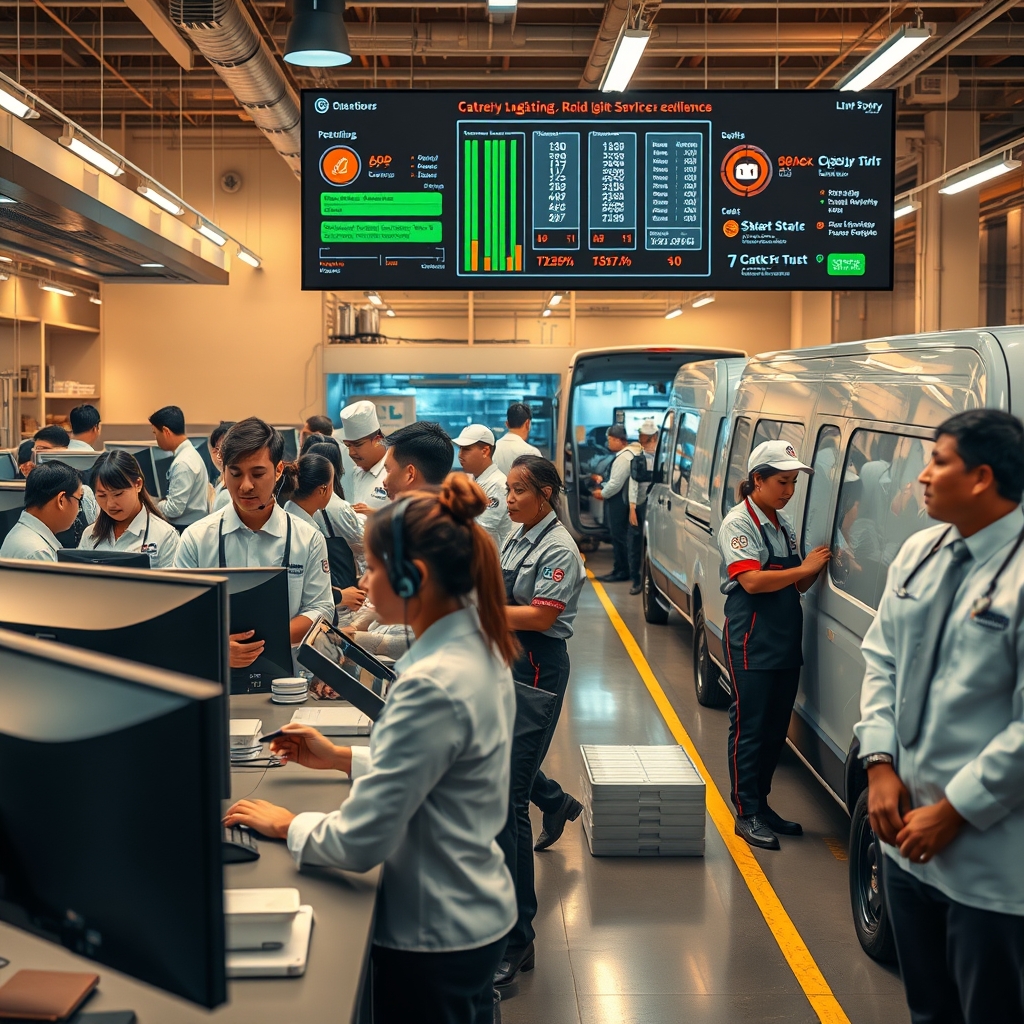
Event catering, in particular, exposes the fragility of this trust. A wedding, a gala, or a product launch hinges on countless variables, many of which are outside the caterer’s control. Yet the client’s perception of success is shaped by what they see—and what they don’t. A seamless experience is one where the catering team arrives early, sets up flawlessly, and disappears without leaving a trace. The logistics behind this illusion are anything but simple. They require a symphony of coordination: kitchen staff, delivery drivers, on-site servers, and customer service reps all working in unison, often across multiple time zones.
The Cloud Kitchen Conundrum
The rise of cloud kitchens has further complicated the catering landscape. These digital-first operations eliminate the overhead of a traditional restaurant but introduce new challenges in customer service. Without a physical storefront, the entire brand experience is distilled into the food and the delivery process. A single misstep—a late order, a missing utensil, a lukewarm dish—can erode trust in ways that are difficult to recover from. For cloud kitchens, customer service isn’t just a department; it’s the lifeline that connects the kitchen to the consumer.
To thrive, these businesses must invest in systems that prioritize transparency. Real-time order tracking, automated updates, and a direct line to a human representative are no longer luxuries but necessities. The goal is to make the customer feel as though they are the only client, even when the kitchen is juggling hundreds of orders simultaneously. This level of personalization requires a blend of technology and human intuition—an algorithm can predict delivery times, but only a person can sense when a client needs reassurance.
The Retail Shop Paradox
Local retail shops and small business services face a similar paradox. In an age dominated by e-commerce giants, they must compete not just on product quality but on the intangibles: convenience, personalization, and trust. A food pickup service or a meal delivery operation that excels in customer service can carve out a niche in even the most crowded markets. The key lies in understanding that logistics and hospitality are not separate functions but two sides of the same coin.
For example, a small bakery offering a pickup and delivery service might use a simple SMS system to notify customers when their order is ready. But the difference between a good service and a great one lies in the details: a handwritten note with the order, a complimentary sample of a new product, or a follow-up message to ensure everything met expectations. These small gestures transform a transaction into a relationship, and relationships are what keep customers coming back.
The catering industry’s future belongs to those who recognize that customer service is not a cost center but a revenue driver. In a world where food can be ordered with a tap and delivered within minutes, the companies that will dominate are those that understand the last mile is not just a logistical challenge but a psychological one. It’s not about moving food from point A to point B; it’s about moving the customer from skepticism to loyalty, one seamless experience at a time. The best catering services don’t just deliver meals—they deliver confidence, and in doing so, they redefine what it means to serve.