The Alchemy of Anticipation: How Catering Services Are Redefining the Economics of Predictive Logistics

The modern catering industry is no longer defined by the mere act of delivering food—it is shaped by the art of delivering it before the customer even realizes they need it. This is the era of predictive logistics, where data, behavior, and operational precision converge to create an ecosystem that doesn’t just respond to demand but anticipates it. The most successful catering services today are those that have mastered the alchemy of turning historical patterns, real-time signals, and customer psychology into a seamless, almost prescient, delivery experience.
The Data Dividend: From Reactive to Predictive
The shift from reactive to predictive logistics is not merely a technological upgrade—it is a fundamental reimagining of how catering services operate. Traditional models relied on static order flows: a client places a request, the kitchen prepares the meal, and logistics execute the delivery. The process was linear, predictable, and inherently limited by the lag between demand and fulfillment. Predictive logistics, however, dismantles this linearity. By analyzing past orders, seasonal trends, event calendars, and even local weather patterns, catering businesses can forecast demand with startling accuracy.
Consider corporate catering, where recurring weekly orders for team lunches or boardroom meetings create a rhythm that algorithms can exploit. A catering service that recognizes a company’s tendency to order Mediterranean platters every second Tuesday can pre-position ingredients, optimize kitchen workflows, and even pre-schedule delivery routes before the order is placed. The result? A reduction in lead times, lower operational costs, and a customer experience that feels effortless—because it was engineered to be.
The Psychology of Proximity: Why Hyper-Local Isn’t Just a Trend
The rise of hyper-local catering networks is not merely a logistical convenience—it is a psychological masterstroke. When a customer orders from a nearby cloud kitchen or a local catering service with a pickup and delivery option, they are not just buying food; they are buying the illusion of immediacy. The closer the kitchen, the shorter the perceived wait time, and the stronger the customer’s sense of control over their experience.
This proximity effect is amplified in urban environments, where the density of demand allows catering services to deploy micro-fulfillment centers—small, strategically located hubs that act as both kitchens and staging areas for deliveries. These centers don’t just reduce delivery times; they redefine the economics of catering by minimizing the cost of last-mile logistics. The result is a service that feels both premium and accessible, a rare combination in an industry where speed and quality are often at odds.
The Frictionless Handoff: Where Technology Meets Trust
The most critical moment in any catering delivery is not the preparation of the food or the efficiency of the route—it is the handoff. A meal that arrives late, cold, or damaged is not just a logistical failure; it is a breach of trust. Predictive logistics addresses this by ensuring that the handoff is not just timely but contextually aware. Smart routing algorithms account for traffic patterns, delivery windows, and even the customer’s preferred drop-off location (front desk, kitchen, or a specific office).
For high-end corporate catering or private events, this level of precision is non-negotiable. A delayed delivery to a boardroom meeting is not just an inconvenience—it is a disruption to the client’s entire agenda. Predictive logistics turns this vulnerability into an opportunity by ensuring that the food arrives not just on time, but at the exact moment it is needed, reinforcing the caterer’s reputation for reliability.
The Unseen Infrastructure: How Cloud Kitchens Are Redefining Scalability
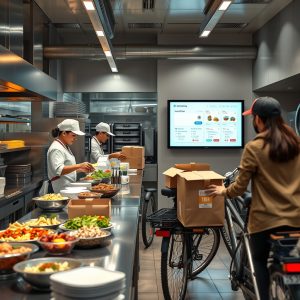
The backbone of predictive logistics is the cloud kitchen—a model that strips away the traditional overhead of brick-and-mortar restaurants and replaces it with a lean, data-driven operation. These kitchens are not just production hubs; they are nerve centers that ingest real-time data from orders, delivery platforms, and customer feedback loops. The result is a system that can scale rapidly, adapt to demand spikes, and pivot between cuisines or service models without the friction of physical expansion.
For small catering businesses, cloud kitchens offer a pathway to compete with larger players by leveraging shared infrastructure and predictive analytics. A local caterer specializing in drop-off services for private events can use cloud kitchen data to anticipate demand for holiday parties, corporate retreats, or even last-minute office celebrations. The ability to scale up or down without the burden of fixed costs is a game-changer in an industry where margins are often razor-thin.
The Customer as Co-Creator: How Predictive Logistics Personalizes the Experience
The most transformative aspect of predictive logistics is its ability to turn passive customers into active participants in the catering process. When a service remembers a client’s dietary preferences, their usual order for team meetings, or their tendency to add a dessert platter at the last minute, it doesn’t just streamline the ordering process—it creates a sense of partnership. The customer feels seen, understood, and valued, which in turn fosters loyalty.
This personalization extends beyond individual orders. Predictive analytics can identify broader trends, such as a company’s shift toward healthier meal options or a neighborhood’s growing preference for plant-based catering. Catering services that act on these insights don’t just meet demand—they shape it, positioning themselves as trendsetters rather than followers. The result is a virtuous cycle: better data leads to better predictions, which lead to better customer experiences, which generate even more data.
The future of catering is not about faster delivery or cheaper meals—it is about creating an ecosystem where the customer’s needs are met before they are articulated. Predictive logistics is the invisible thread that weaves together speed, trust, and personalization into a seamless experience. The businesses that thrive will be those that recognize this not as a technological challenge, but as a fundamental shift in how catering services engage with their customers. The question is no longer whether a meal can be delivered on time, but whether the entire process can be so finely tuned that the customer never has to think about it at all.