The Algorithm of Hospitality: Why Drop-Off Catering and Micro-Logistics Now Dominate
The era of the sprawling, labor-intensive banquet is drawing to a close. In its place, a streamlined, hyper-efficient model has emerged, stripping the food service business of its traditional pageantry. We are witnessing the industrialization of hospitality, where the metric of success is no longer just culinary prowess, but the frictionless execution of an online catering order. The modern palate demands immediacy, and the market has responded by replacing the chafing dish with the algorithm. To understand this shift, one must look at the underlying economics that govern both small business services and massive corporate contracts. The transformation is a structural necessity driven by an increasingly impatient consumer base and the relentless pressure of urban operating costs within the broader landscape of catering services.
The Inefficiencies of Traditional Event Catering
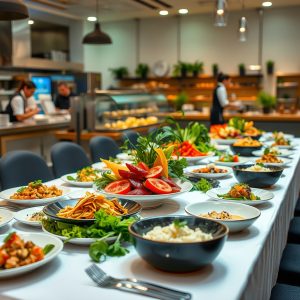
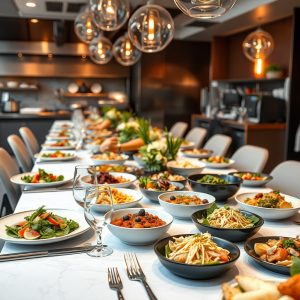
Traditional event catering operates on a fundamentally flawed economic premise. The overhead required to maintain a full-service food catering business—encompassing front-of-house staff, specialized transport for bulky equipment, and on-site assembly—creates an unsustainable margin structure. For decades, clients absorbed these inflated costs under the guise of “experience.” However, the corporate sector, a primary driver of revenue, has ruthlessly audited this expense. Corporate catering is no longer a localized luxury; it is a line item that demands maximum return on investment. The bloated infrastructure of legacy caterers renders them incapable of competing in an environment that prioritizes speed and scalability. Furthermore, the inherent unpredictability of the old model introduces unacceptable levels of operational risk. When a client orders food for a critical meeting, they are not just purchasing a meal; they are purchasing certainty.
The Pivot to Drop Off Catering
Consequently, the industry is witnessing a massive capital reallocation toward drop off catering and streamlined fulfillment. This pivot is not a downgrade in quality, but a recalibration of value. Clients are opting to pay for the product itself rather than the performative labor of on-site serving staff. By utilizing a highly optimized pickup and delivery service model, food providers can execute multiple orders simultaneously, drastically increasing their daily volume. The logistics service business has effectively swallowed the catering industry, proving that precise routing software is just as critical to a successful meal as the chef’s knife. Instead of dedicating an entire team to a single event, that same team can produce fifty distinct orders, shattering previous revenue ceilings and optimizing labor schedules with terrifying accuracy.
The Architecture of the Cloud Kitchen Business
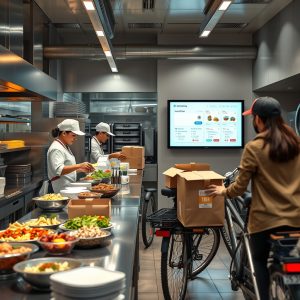
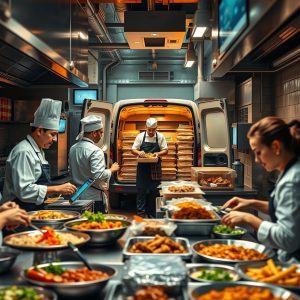
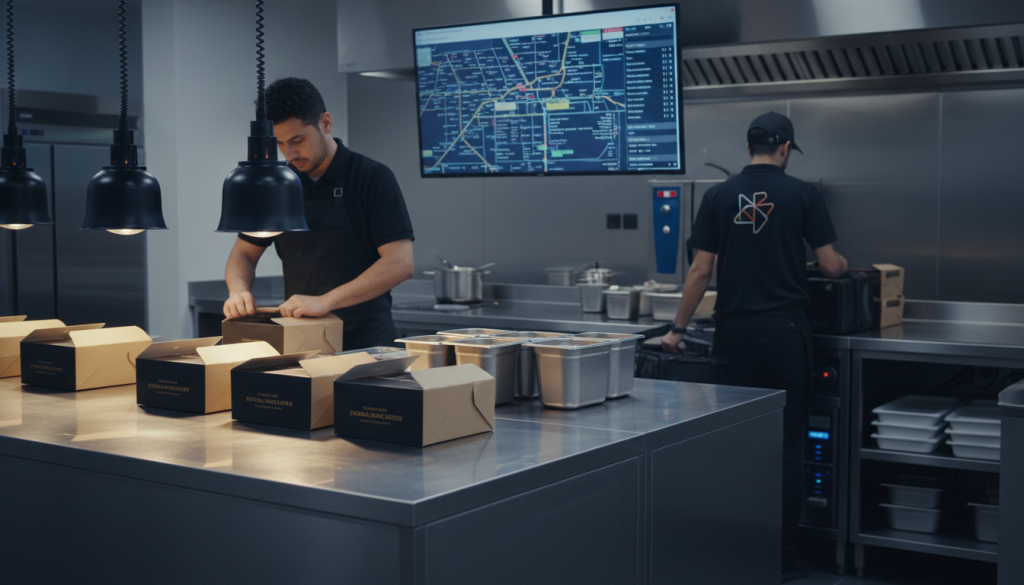
At the center of this operational revolution is the cloud kitchen business. By decoupling food production from the retail shop services model, these facilities eliminate the crippling real estate costs associated with prime commercial locations. A cloud kitchen operates as a culinary manufacturing plant, optimized exclusively for meal delivery service and food pickup service. There are no dining rooms to heat, no front-of-house staff to manage, and no aesthetic compromises. Every square foot is dedicated to production and the seamless handoff to couriers. This architectural shift isolates the variables of hospitality, stripping away the unpredictable nature of foot traffic and allowing operators to focus entirely on output.
Logistics as the New Culinary Standard
These centralized facilities function as logistical hubs rather than traditional restaurants. They are designed from the ground up to interface seamlessly with a catering delivery service, featuring dedicated loading zones and algorithmic dispatch systems. This ensures couriers spend seconds, not minutes, waiting for an order. In this hyper-commodified landscape, the definition of customer service excellence has fundamentally changed. It is no longer defined by the attentiveness of a waiter, but by the accuracy of a digital interface and the reliability of on demand services. When an office manager realizes that an order for fifty executives can be modified with three clicks and delivered with zero friction, they will never return to the cumbersome negotiation processes of traditional caterers.
Engineering the Express Delivery Service
When a client places an order, the expectation is absolute transparency. They demand real-time GPS tracking, precise temperature control upon arrival, and packaging that preserves the integrity of the dish during an express delivery service route. Networks offering local shop delivery that fail to meet these stringent logistical standards are rapidly marginalized. Customer service excellence in this context means anticipating points of friction before they occur. It means utilizing thermal-insulating materials that maintain optimal serving temperatures without causing condensation to ruin the texture of the food. The digital interface is the new maitre d’, and the delivery driver is the new server. Any friction in this digital-to-physical pipeline results in immediate customer churn. Menus are being aggressively reverse-engineered; dishes that degrade over a thirty-minute transit window are ruthlessly excised from the repertoire.
The democratization of logistics has ultimately empowered independent operators across the board. A specialized home catering service can now leverage off-the-shelf routing software to offer professional-grade fulfillment across a metropolitan area, competing directly with legacy institutions. The survival of any entity within this new ecosystem hinges on its willingness to embrace this logistical reality. The romanticized vision of bespoke, on-site creation has been permanently overridden by the demand for scalable, predictable, and frictionless fulfillment. As algorithms continue to dictate the flow of urban commerce, the distinction between a culinary enterprise and a logistics network will entirely dissolve. The plate is merely the payload; the true mastery lies in the supply chain that brings it to the table.