The Logistics of Taste: How On-Demand Systems Are Dismantling Traditional Catering
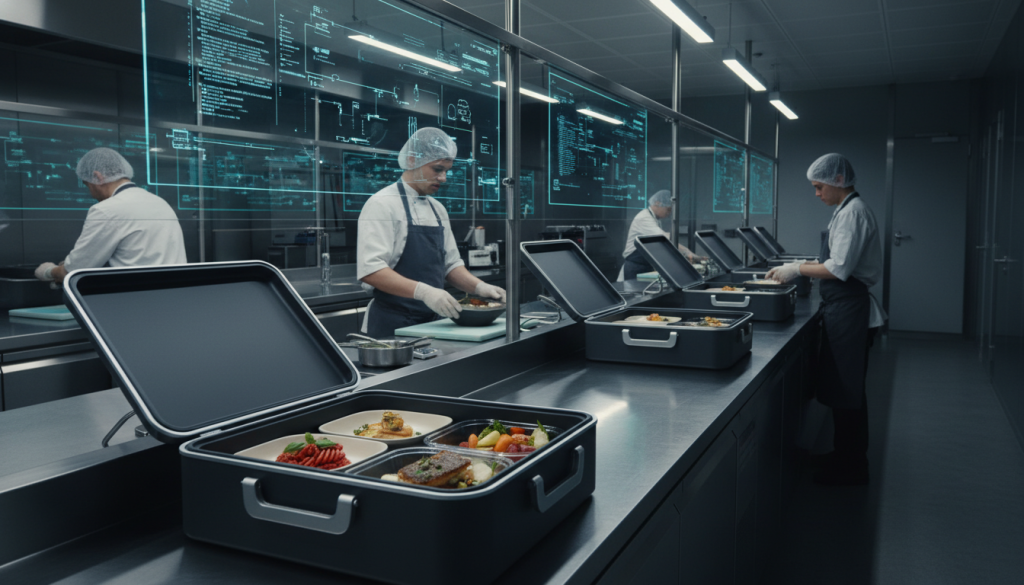
The contemporary food service business is undergoing a structural metamorphosis. The days when event catering relied solely on culinary prestige and word-of-mouth are definitively over. Today, the operational baseline demands a rigorous fusion of gastronomy and high-speed logistics. We are witnessing the systematic dismantling of traditional hospitality models, replaced by highly optimized, data-driven frameworks where an online catering order holds the exact same weight and requires the same precision as a grand corporate banquet.
This shift is not merely a change in consumer preference; it is a fundamental realignment of industry economics. The modern consumer, conditioned by on-demand services in every other sector, now expects the same immediacy and precision in their food delivery. Whether it is a daily meal delivery service or large-scale corporate catering, the margin for error has evaporated. Excellence is no longer defined strictly by the palate, but by the stopwatch, the packaging integrity, and the routing algorithm.
The Deconstruction of Traditional Catering
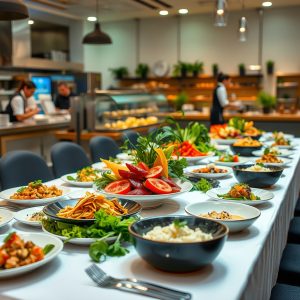
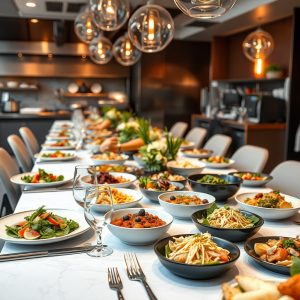
Historically, the food catering business operated on predictable timelines. Menus were finalized weeks in advance, prep was meticulously scheduled, and execution happened on-site. The current landscape shatters this predictability. The rise of express delivery service and on-demand drop off catering forces operators to maintain perpetual readiness. A corporate client may now expect a multi-course luncheon for fifty executives with only a twenty-four-hour notice, demanding the exact same quality as a meticulously planned gala.
To survive this severe compression of time, catering services must pivot from artisanal kitchens to agile production hubs. Traditional retail shop services, burdened by front-of-house overhead and localized foot traffic, are increasingly ill-equipped to handle the volume and velocity required by modern catering delivery services. The physical storefront is rapidly becoming a liability rather than an asset, prompting a mass migration toward decentralized production models.
The Cloud Kitchen Catalyst
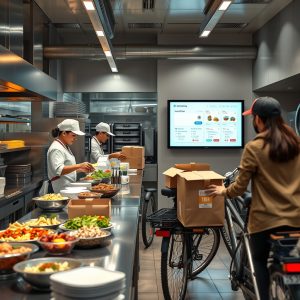
Enter the cloud kitchen business. By stripping away the dining room and the customer-facing facade, operators can redirect capital directly into production efficiency and logistics service business integration. Cloud kitchens operate strictly as fulfillment centers for online catering orders. This model allows a single facility to execute multiple distinct menus—ranging from high-end corporate catering to casual home catering service—without the brand confusion that would plague a traditional restaurant attempting the exact same feat.
However, the cloud kitchen is not a panacea. It trades front-of-house expenses for complex logistical dependencies. When a business removes the experiential element of dining in, the product must speak entirely for itself upon arrival. This places immense pressure on packaging, temperature retention, and the pickup and delivery service network. A flawless dish that arrives lukewarm or visually compromised due to poor transit mechanics is an immediate failure in the eyes of the consumer.
Logistics as the Ultimate Differentiator
In the current paradigm, a food service business is fundamentally a logistics company that happens to sell food. The operational bottleneck is rarely the kitchen; it is the supply chain connecting the kitchen to the consumer. Food pickup service and drop off catering require exacting precision. The difference between customer retention and customer churn often comes down to a five-minute delivery window or the structural integrity of a transport container.
The Mechanics of Drop-Off and Express Delivery
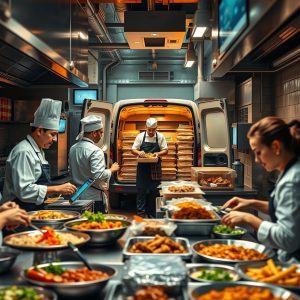
Analyzing the mechanics of a successful catering delivery service reveals a strict reliance on sophisticated routing software and dynamic fleet management. Unlike standard parcel delivery, food transport involves highly perishable, time-sensitive cargo. Drop off catering for corporate events requires seamless coordination between the kitchen output and the dispatch of specialized vehicles. The logistics service business model must account for traffic patterns, staging times, and the physical constraints of the delivery location.
Small business services attempting to enter this space frequently underestimate the capital required to build a resilient delivery infrastructure. Relying entirely on third-party local shop delivery networks often results in compromised quality control. To achieve true customer service excellence, catering operators must internalize at least a portion of their logistics, maintaining strict oversight over how their product is handled from the moment it leaves the pass to the moment it breaches the client’s threshold.
Redefining Customer Service Excellence
The concept of hospitality has been irrevocably altered. In a traditional setting, customer service excellence was delivered through interpersonal interaction—an attentive waiter, an accommodating maître d’, the ambiance of the room. In the era of the online catering order, the transaction is largely faceless. Therefore, the metrics for service have shifted entirely to accuracy, speed, and the anticipation of logistical friction.
A premium home catering service or meal delivery service must engineer its packaging to be highly intuitive. Are the reheating instructions clear? Is the unboxing experience aesthetically pleasing? Are the dietary restrictions explicitly labeled to prevent cross-contamination anxiety? These are the new touchpoints of hospitality. When a client utilizes a food pickup service, their primary interaction is with the digital interface and the final physical product. Any friction in the ordering process or ambiguity in the final delivery instantly degrades the perceived value of the food itself.
The operators who will dominate the next decade of the food service industry are those who recognize that culinary talent is merely the entry fee. True market authority is forged at the intersection of gastronomy and industrial engineering. By treating every online order, every drop-off catering event, and every local delivery as a rigorous logistical exercise, brands can deliver consistency at scale. The plate is no longer the final destination; it is simply the starting point of a complex, highly choreographed journey that demands absolute precision at every operational turn.