The Logistics Labyrinth: Why Catering Delivery Services Must Master the Art of the Unseen Handoff

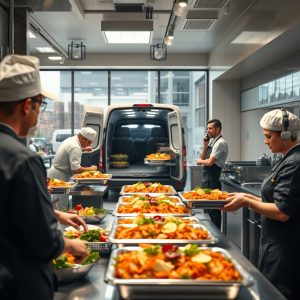
The modern catering industry is no longer defined by the quality of the food alone. The battleground has shifted—from the kitchen to the last mile, from the chef’s expertise to the precision of an unseen logistics network. What was once a straightforward transaction—order, prepare, deliver—has morphed into a complex dance of timing, temperature control, and customer psychology. The rise of on-demand services, cloud kitchens, and hyper-local delivery has not just expanded the market; it has redefined the very expectations of what catering should be. And yet, for all the innovation, the most critical moment remains the one that happens in silence: the handoff.
The Illusion of Simplicity
To the customer, a successful catering delivery appears effortless. A few taps on an app, a confirmation ping, and within hours, a perfectly arranged spread arrives at the doorstep—hot, fresh, and ready to impress. But behind this illusion of simplicity lies a labyrinth of decisions, each with the potential to derail the entire experience. The challenge is not just getting the food from point A to point B; it’s ensuring that the journey is invisible, that the customer never has to think about the how, only the what.
Consider the variables at play: traffic patterns that shift by the hour, weather conditions that can turn a 20-minute drive into a 45-minute slog, last-minute order changes that force a kitchen to recalibrate its entire workflow. Then there’s the human element—the delivery driver who must navigate unfamiliar office buildings, the event planner who forgot to mention the service elevator is out of order, the corporate client who expects the meal to arrive precisely at 12:00 PM, not a minute before or after. Each of these factors demands not just logistical precision, but a kind of anticipatory intelligence, a system that can adapt in real time without the customer ever sensing the friction.
The Tyranny of the Last Mile
In logistics, the last mile is often the most expensive, the most unpredictable, and the most critical. For catering services, it’s where reputations are made or broken. A meal that leaves the kitchen in pristine condition can arrive lukewarm, soggy, or worse—spilled—if the last mile isn’t executed with surgical precision. The problem is compounded by the nature of catering itself: unlike a single meal delivery, where a minor delay or temperature fluctuation might be forgiven, catering is a high-stakes affair. A delayed delivery to a corporate boardroom isn’t just an inconvenience; it’s a disruption to a carefully orchestrated event. A poorly packed tray of hors d’oeuvres at a wedding isn’t just a logistical failure; it’s a memory marred.
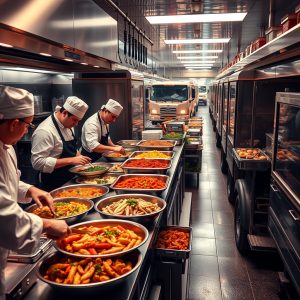
The solution lies in rethinking the last mile not as a single, linear journey, but as a series of micro-interactions. Some catering businesses have begun to adopt a hub-and-spoke model, where centralized kitchens prepare the bulk of the order, and satellite locations handle the final assembly and delivery. Others are leveraging real-time tracking and AI-driven route optimization to shave minutes off delivery times. But the most successful services go further, embedding redundancy into their systems—backup drivers, insulated packaging with temperature monitoring, even contingency menus for high-risk deliveries. The goal isn’t just to deliver on time; it’s to make the customer forget that delivery was ever a concern.
The Psychology of the Unseen
What separates a good catering delivery service from a great one isn’t just operational efficiency; it’s an understanding of human psychology. Customers don’t just want their food delivered; they want to feel like they’ve been taken care of. This is where the concept of the “unseen handoff” becomes crucial. The best services make the delivery feel like a natural extension of the event itself, as if the food simply materialized at the right moment, in the right place, without any effort on the customer’s part.
This requires more than just punctuality. It demands a level of customization that goes beyond the menu. For corporate catering, it might mean providing discreet setup services so that employees never see the delivery process. For event catering, it could involve coordinating with venue staff to ensure seamless integration with the event’s flow. For home catering, it might mean offering white-glove service, where the delivery team not only drops off the food but also sets the table, arranges the platters, and even disposes of packaging. The key is to make the logistics invisible, so the customer’s focus remains solely on the experience.
The Cloud Kitchen Paradox
The rise of cloud kitchens has been a double-edged sword for the catering industry. On one hand, they’ve lowered the barrier to entry, allowing small businesses to compete with established players by leveraging shared kitchen spaces and on-demand delivery networks. On the other, they’ve flooded the market with options, making it harder for any single service to stand out. The result is a landscape where differentiation is no longer about the food alone, but about the entire delivery ecosystem.
For cloud kitchens, the challenge is to avoid becoming a commodity. The most successful operations recognize that catering isn’t just about volume; it’s about precision. They invest in specialized packaging that maintains temperature and presentation, train their staff to handle high-touch deliveries, and build relationships with local event planners and corporate clients. They understand that in a world where customers can order from a dozen different services with a single click, the real competition isn’t just price or speed—it’s trust. And trust is built in the details: the handwritten note included with the delivery, the follow-up call to ensure everything arrived as expected, the willingness to go above and beyond when something goes wrong.
The Future of the Frictionless Feast
The next frontier in catering delivery isn’t just about faster routes or smarter algorithms; it’s about creating a system where the customer’s only concern is whether to go for the chicken or the fish. The companies that will dominate this space are those that treat logistics not as a necessary evil, but as the core of their value proposition. They’ll be the ones who understand that the most important part of the delivery isn’t the food—it’s the moment the customer first lays eyes on it, when they realize that everything has gone exactly as planned, without them having to lift a finger.
The irony is that the more seamless the experience becomes, the less the customer notices the effort behind it. And that’s the point. The best catering delivery services don’t just meet expectations; they erase the very idea that there were expectations to begin with. They turn the complex into the effortless, the logistical into the magical. And in doing so, they don’t just deliver food—they deliver peace of mind.