The Invisible Orchestra: How Catering Services Harmonize Logistics, Customer Expectations, and Culinary Artistry

The modern catering industry is no longer just about food—it is a high-stakes performance where logistics, customer expectations, and culinary precision converge in a delicate balance. The rise of on-demand services, cloud kitchens, and express delivery has transformed catering from a static service into a dynamic, real-time operation where every second counts. Yet, beneath the surface of seamless drop-off catering and frictionless online orders lies an intricate orchestra of moving parts, each playing a critical role in delivering not just meals, but experiences.
The Logistics Paradox: Speed vs. Sensory Integrity
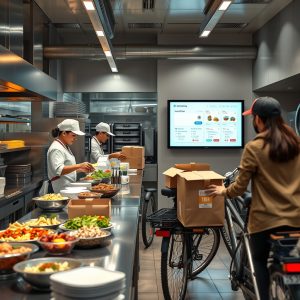
In an era where consumers demand both immediacy and excellence, catering services face an existential paradox: how to deliver food at the speed of desire without compromising its sensory integrity. The answer lies not in brute-force logistics but in strategic orchestration. Express delivery services, for instance, have redefined the last mile by leveraging micro-fulfillment centers and hyper-local hubs, ensuring that meals arrive not just quickly, but at the peak of their quality. This is not merely about reducing transit time—it is about controlling variables: temperature, texture, presentation, and even the psychology of anticipation.
Consider the corporate catering sector, where punctuality is non-negotiable. A delayed lunch delivery can disrupt an entire boardroom meeting, eroding trust in the service provider. Here, logistics become a silent ambassador of reliability. Advanced routing algorithms, real-time tracking, and predictive analytics now allow caterers to anticipate delays before they occur, rerouting deliveries dynamically to maintain the illusion of effortless precision. The result? A service that feels less like a transaction and more like a carefully choreographed performance.
The Cloud Kitchen Revolution: Decoupling Production from Presentation
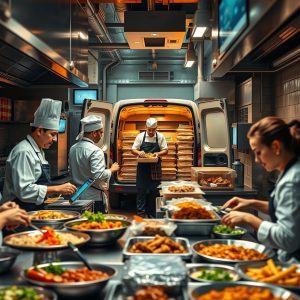
The emergence of cloud kitchens has further disrupted traditional catering models by decoupling food production from physical storefronts. These ghost kitchens, optimized for delivery and pickup services, operate with surgical efficiency, reducing overhead while maximizing output. For catering businesses, this model offers a dual advantage: the ability to scale rapidly without the constraints of brick-and-mortar locations and the flexibility to tailor menus for specific events or corporate clients without the burden of excess inventory.
Yet, the cloud kitchen model is not without its challenges. Without a physical presence, customer trust must be earned through consistency, transparency, and flawless execution. This is where the art of the unseen handoff becomes critical. Whether it’s a meal delivery service dropping off a gourmet spread for a private event or a corporate catering order arriving at a high-stakes conference, the moment of delivery is where perception is forged. A misstep here—be it a lukewarm dish, a damaged container, or an unprofessional courier—can unravel months of brand-building in an instant.
The Human Element: Why Customer Service Excellence Remains Non-Negotiable
In the rush to automate and optimize, many catering services overlook the one variable that no algorithm can replicate: human touch. Customer service excellence is not just about resolving complaints—it is about anticipating needs, personalizing interactions, and turning logistical constraints into opportunities for connection. A pickup and delivery service that remembers a client’s dietary preferences, a corporate caterer that adjusts portion sizes based on past feedback, or an event catering team that proactively communicates delays—these are the nuances that elevate a service from functional to unforgettable.
Moreover, the rise of on-demand expectations has made responsiveness a competitive differentiator. A client who can track their catering order in real-time, receive proactive updates, and engage with a support team that resolves issues before they escalate is a client who will return. This is the invisible thread that weaves customer loyalty beyond the plate. In an industry where margins are thin and competition is fierce, the ability to turn a one-time order into a recurring relationship is the ultimate measure of success.
The Future of Catering: Beyond the Last Mile
The next frontier for catering services lies in predictive personalization—using data not just to react to demand but to anticipate it. Imagine a corporate catering platform that learns a company’s ordering patterns, suggests menus based on past preferences, and even adjusts delivery windows based on meeting schedules. Or an event catering service that integrates with venue management software to ensure seamless coordination between food delivery, setup, and service. These are not distant possibilities but imminent realities, driven by the convergence of AI, logistics, and customer-centric design.
Yet, as catering services evolve, one truth remains constant: the best logistics in the world cannot compensate for a lack of culinary soul. The most successful caterers will be those who recognize that technology is a tool, not a replacement for the artistry of food. Whether it’s a home catering service crafting bespoke meals for intimate gatherings or a cloud kitchen fulfilling hundreds of orders daily, the goal remains the same—to deliver not just sustenance, but an experience that lingers long after the last bite.
The catering industry’s greatest challenge—and its most exciting opportunity—lies in mastering the alchemy of precision and passion. In a world where convenience is king, the services that thrive will be those that remember the human at the heart of every order, every delivery, and every meal. The invisible orchestra plays on, but its most powerful instrument has always been the ability to make the complex feel effortless, the transactional feel personal, and the ordinary feel extraordinary.