The Last Mile Illusion: How Catering Services Are Weaponizing Convenience Against Customer Expectations
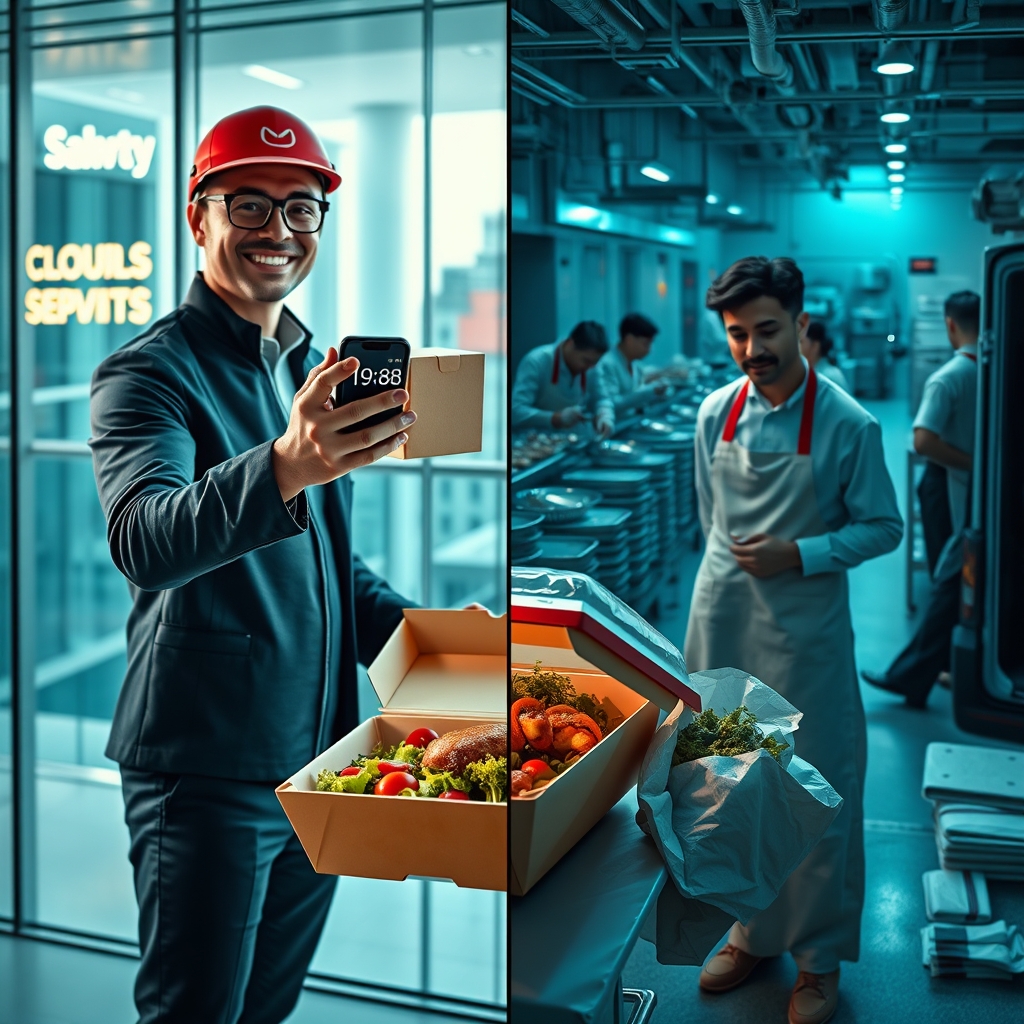
The modern catering industry operates under a seductive illusion: that convenience is the ultimate currency. The promise is simple—food arrives at your doorstep, office, or event venue with minimal friction, maximal speed, and an aura of effortless luxury. But this illusion is not accidental. It is a carefully constructed narrative, one that obscures the relentless operational pressures, logistical gymnastics, and psychological manipulations that make it possible. The last mile, far from being a mere delivery phase, has become a battleground where catering services weaponize convenience to reshape customer expectations, often at the expense of quality, sustainability, and even basic transparency.
The Convenience Paradox: Speed as a Substitute for Value
In an era where on-demand services dominate, catering businesses have internalized a dangerous equation: faster equals better. The rise of express delivery, cloud kitchens, and hyper-local logistics has conditioned consumers to prioritize immediacy over all else. A corporate lunch ordered at 11:45 AM must arrive by 12:30 PM, not because the food is fresher or the presentation superior, but because the customer’s internal clock has been recalibrated to demand it. This is not evolution—it is coercion. Catering services, once defined by craftsmanship and culinary artistry, now compete in a race to the bottom, where the only metric that matters is the timestamp on a delivery notification.
The problem is not speed itself, but the way it has been weaponized to erode other critical factors. A meal that arrives in 20 minutes may be lukewarm, poorly plated, or lacking in the customization promised during the online order process. Yet, the customer, seduced by the illusion of efficiency, often overlooks these flaws. The catering industry has mastered the art of distraction—redirecting attention from the product to the process, from the sensory experience to the logistics. This is the convenience paradox: the more we prioritize speed, the less we demand of the actual food.
The Logistics Mirage: How Catering Services Hide the Chaos
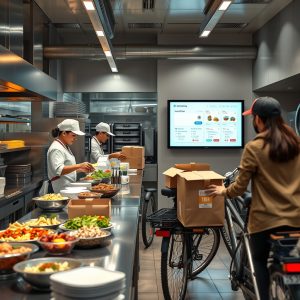
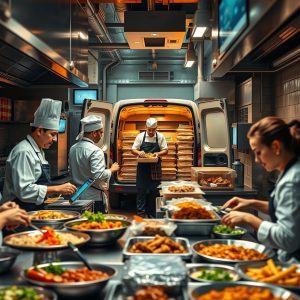
Behind the seamless facade of a drop-off catering order lies a labyrinth of inefficiencies, last-minute pivots, and logistical acrobatics. The modern catering delivery service is less a well-oiled machine and more a high-stakes juggling act, where one delayed driver, a mislabeled order, or an unexpected traffic snarl can unravel the entire operation. Yet, customers rarely see this chaos. What they experience is a frictionless transaction—an app notification, a polite delivery person, and a box of food that appears as if by magic.
This mirage is maintained through a combination of micro-logistics, predictive algorithms, and sheer human ingenuity. Cloud kitchens, for instance, are not just cost-saving measures; they are strategic tools for masking operational complexity. By centralizing production in off-site locations, catering businesses can present a veneer of consistency, even when the underlying logistics are anything but. The food may travel farther, pass through more hands, and endure more temperature fluctuations, but the customer remains blissfully unaware. The illusion holds because the industry has convinced us that convenience is a zero-sum game—either we get speed, or we get quality, but never both.
The Customer Service Trap: When Convenience Becomes a Hostage Situation
Customer service in the catering industry has devolved into a damage-control mechanism, where the primary goal is not to delight, but to contain. The moment a delivery is late, a dish is incorrect, or a meal arrives in less-than-perfect condition, the customer service apparatus springs into action—not to fix the root problem, but to placate the customer with refunds, discounts, or empty apologies. This is not service excellence; it is hostage negotiation. The industry has trained consumers to expect failure, then rewards them for tolerating it.
The most insidious aspect of this dynamic is how it shifts responsibility. If a meal arrives cold, the customer is often blamed for not ordering sooner, choosing the wrong delivery window, or failing to specify their preferences clearly enough. The catering service, meanwhile, absolves itself of accountability by pointing to the inherent unpredictability of logistics. This is the customer service trap: convenience is sold as a privilege, not a right, and any failure is framed as an exception rather than a systemic flaw.
The Sustainability Blind Spot: How Convenience Fuels Waste
The environmental cost of the last-mile illusion is staggering. The catering industry’s obsession with speed and convenience has led to an explosion of single-use packaging, inefficient delivery routes, and food waste. A meal that arrives in 30 minutes may have been prepared in a cloud kitchen 10 miles away, driven in a gas-guzzling van, and packaged in enough plastic to fill a landfill. Yet, because the customer only sees the final product—a neatly boxed meal—they remain disconnected from the ecological footprint of their convenience.
Some catering businesses have attempted to address this by offering eco-friendly packaging or carbon-neutral delivery options, but these are Band-Aid solutions. The real issue is the industry’s refusal to challenge the underlying assumption that faster is always better. Until catering services acknowledge that convenience comes at a cost—one that is often borne by the environment and future generations—they will continue to prioritize speed over sustainability.
The Future of Catering: Breaking the Illusion or Doubling Down?
The catering industry stands at a crossroads. One path leads to a future where convenience is no longer an illusion but a genuine enhancement of the customer experience—where speed and quality coexist, where logistics are transparent, and where sustainability is not an afterthought but a core value. The other path is a continuation of the status quo, where the last mile remains a battleground of psychological manipulation, where customers are conditioned to accept mediocrity in exchange for speed, and where the true costs of convenience are hidden behind a veneer of seamless service.
The choice is not just about logistics or technology; it is about integrity. Catering services that break the illusion will not only earn customer loyalty but also redefine what it means to deliver excellence. Those that double down on the illusion, however, will find themselves trapped in a cycle of diminishing returns, where the pursuit of convenience ultimately erodes the very thing it promises to deliver. The last mile is not just a delivery phase—it is a test of whether the catering industry can evolve beyond the seductive but hollow promise of speed and embrace a future where convenience is not an end in itself, but a means to something greater.