The Last Mile Liturgy: How Catering Services Are Weaponizing Sensory Logistics to Command Unbreakable Customer Devotion
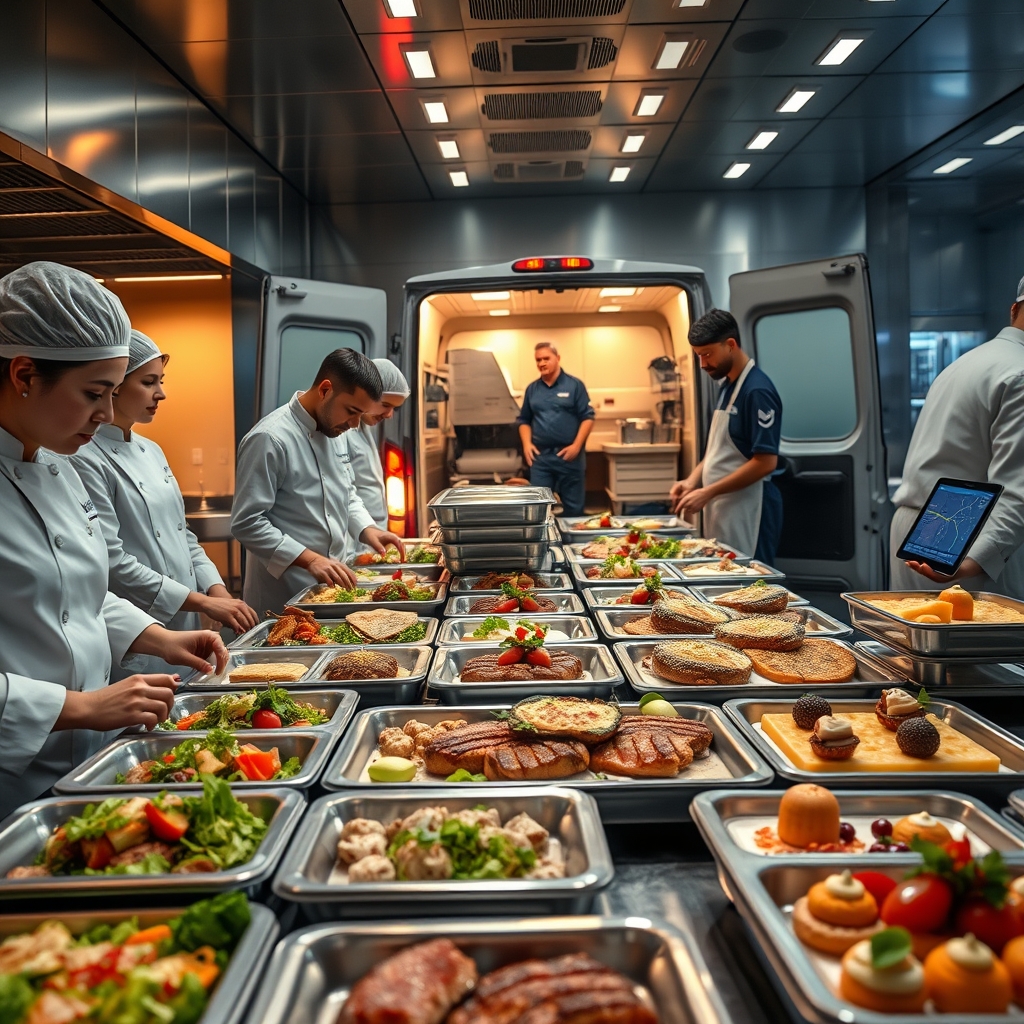
The modern catering industry is no longer just about food—it is about the orchestration of an experience. Every dish that arrives at a corporate luncheon, a wedding reception, or a private dinner party is the culmination of a complex logistical ballet, where timing, temperature, and presentation converge to create an illusion of effortless perfection. The real battleground, however, is not in the kitchen but in the final stretch: the last mile. This is where catering services either solidify their reputation or unravel under the weight of expectation. The most successful players in this space have mastered what can only be described as sensory logistics—a discipline that transcends mere delivery and instead engineers an emotional connection with the customer.
The Illusion of Spontaneity
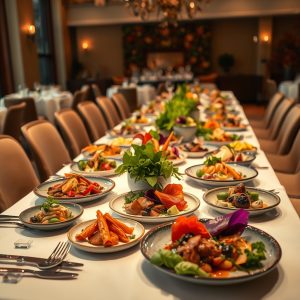
In an era where on-demand services have conditioned consumers to expect immediacy, catering businesses face a paradox: the more seamless the experience, the more invisible the effort behind it must be. A corporate client ordering a 200-person lunch spread does not want to see the chaos of coordination—just the flawless execution. This is where sensory logistics come into play. It is not enough for the food to arrive on time; it must arrive in a state that feels as though it was prepared moments ago, regardless of the distance traveled or the time spent in transit. The art lies in manipulating perception—chilled salads that retain their crispness, warm entrées that arrive at the perfect temperature, and desserts that look as though they were plated on-site.
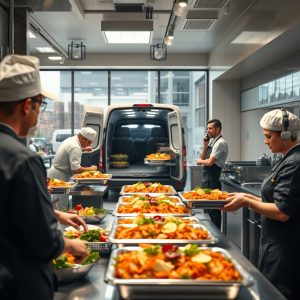
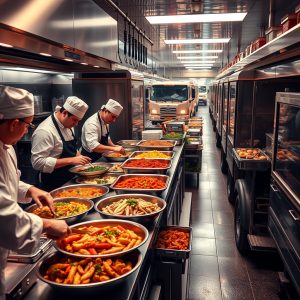
Cloud kitchens and drop-off catering services have become the unsung heroes of this illusion. By centralizing production in strategically located hubs, they minimize the time between preparation and delivery, ensuring that the sensory integrity of the food remains intact. The result? A corporate event that feels bespoke, even if the logistics behind it are anything but. The customer does not see the refrigerated vans, the insulated containers, or the real-time GPS tracking—just the end product, which must feel like an act of culinary spontaneity.
The Psychology of the Last Mile
The last mile is not just a logistical challenge; it is a psychological one. Studies in consumer behavior reveal that the final moments of a service interaction disproportionately influence overall satisfaction. A catering delivery that arrives five minutes late, even if the food is impeccable, can sour an entire experience. Conversely, a delivery that exceeds expectations—perhaps with a handwritten note, a complimentary appetizer, or an unexpected upgrade—can turn a one-time client into a lifelong advocate.
This is where customer service excellence becomes the linchpin of sensory logistics. The most successful catering businesses understand that the last mile is not just about moving food from point A to point B; it is about moving emotions. A driver who arrives with a smile, a chef who personally checks the order before it leaves the kitchen, or a customer service representative who follows up to ensure satisfaction—these are the touches that transform a transaction into a relationship. In the age of on-demand services, where convenience is commoditized, the businesses that thrive are those that weaponize the last mile to create moments of delight.
The Economics of Sensory Integrity
For catering services, the stakes of sensory logistics extend beyond customer satisfaction—they are a matter of economic survival. The cost of a single failed delivery can be catastrophic, not just in terms of refunds or lost business, but in the erosion of trust. A wedding caterer whose cake arrives melted, a corporate caterer whose hot dishes arrive lukewarm, or a meal delivery service whose packaging fails to preserve freshness—these are not just logistical failures, but brand failures. The economics of the last mile are brutal: one misstep can undo years of reputation-building.
This is why the most forward-thinking catering businesses are investing heavily in logistics technology. Real-time temperature monitoring, route optimization algorithms, and AI-driven demand forecasting are no longer luxuries but necessities. The goal is not just to deliver food, but to deliver an experience that feels curated, even if it is mass-produced. The irony? The more technology is used to streamline the process, the more human the experience must feel. A perfectly timed delivery is meaningless if the customer feels like just another order number. The challenge, then, is to use data and automation to enhance, rather than replace, the human touch.
The Future of Frictionless Feasting
The next frontier of catering logistics lies in the fusion of hyper-local efficiency and hyper-personalized service. As urbanization accelerates and consumer expectations continue to rise, catering businesses must find ways to operate at scale without sacrificing the intimacy that defines great service. This is where the concept of micro-fulfillment comes into play—small, localized hubs that allow for rapid response times and customized offerings. Imagine a network of cloud kitchens, each specializing in a different cuisine, all connected by a seamless logistics platform that ensures every order, no matter how complex, arrives as though it were hand-delivered by the chef themselves.
The rise of express delivery services and on-demand logistics has also opened new avenues for catering businesses to expand their reach. A small, family-owned catering company can now compete with corporate giants by leveraging third-party delivery platforms, provided they can maintain control over the last mile. The key is to treat these platforms not as crutches, but as force multipliers—tools that extend reach while preserving the brand’s commitment to sensory excellence.
The catering industry is at a crossroads. On one side lies the commoditization of food service, where price and speed dictate success. On the other lies the elevation of catering into an art form, where logistics, psychology, and culinary skill converge to create something greater than the sum of its parts. The businesses that will dominate the future are those that recognize the last mile not as a logistical hurdle, but as a canvas for sensory storytelling. Every delivery is an opportunity to reinforce trust, exceed expectations, and turn a fleeting interaction into a lasting memory. The question is not whether catering services can afford to invest in sensory logistics—it is whether they can afford not to.