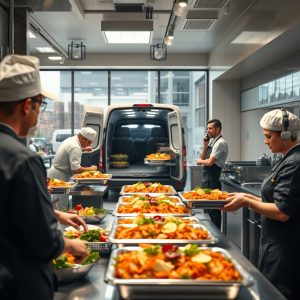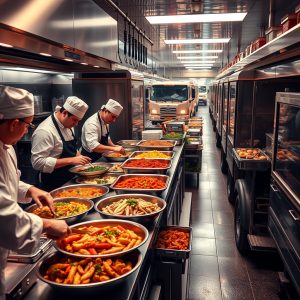
The Silent Contract: How Catering Logistics Forge Unspoken Bonds Between Flavor and Fidelity

The modern catering industry is no longer just about the food—it is about the unspoken contract between provider and consumer, where logistics become the invisible ink that writes trust. Every successful catering service, whether corporate, event-based, or home delivery, operates on a delicate balance of precision, anticipation, and execution. The moment a customer places an order, they enter into an implicit agreement: that the meal will arrive on time, at the right temperature, and in the exact condition promised. The logistics behind this transaction are far more complex than mere transportation; they are the backbone of customer loyalty in an era where convenience is currency.
The Illusion of Simplicity
To the end consumer, the process appears seamless—a few taps on an app, a confirmation notification, and within hours, a meal arrives at their doorstep. Yet behind this illusion of simplicity lies a labyrinth of micro-decisions: route optimization, real-time traffic adjustments, packaging integrity, and temperature control. The most successful catering businesses understand that the last mile is not just a logistical challenge but a psychological one. A delayed delivery doesn’t just disrupt a meal; it fractures trust. Conversely, a flawless handoff reinforces the belief that the service is reliable, even infallible.
This is where the distinction between a good catering service and a dominant one becomes clear. The former treats logistics as a necessary evil—a means to an end. The latter treats it as a competitive weapon, refining every variable to eliminate friction. Cloud kitchens, for instance, have redefined the economics of catering by stripping away the overhead of physical dining spaces and focusing solely on production and delivery. The result? Faster turnaround times, lower costs, and the ability to scale without the constraints of traditional restaurant models. Yet even these digital-first operations must grapple with the same fundamental truth: logistics are the difference between a one-time customer and a lifelong advocate.
The Psychology of the Unseen
What makes catering logistics so fascinating is their invisibility. When executed perfectly, they go unnoticed—like the stagehands of a theater production, ensuring the show goes on without drawing attention to themselves. But when they fail, the disruption is immediate and glaring. A lukewarm dish, a missing utensil, or a delivery that arrives an hour late doesn’t just disappoint; it violates the unspoken contract. The customer doesn’t just remember the mistake—they remember the brand that made it.
This is why the most forward-thinking catering services invest as much in their logistics infrastructure as they do in their culinary offerings. Real-time tracking, predictive analytics, and AI-driven route optimization are no longer luxuries but necessities. The goal is not just to deliver food but to deliver an experience—one where the customer feels in control, even when they’re not. The rise of on-demand catering has conditioned consumers to expect immediacy, but it has also made them more forgiving of minor delays if they’re kept informed. Transparency, in this context, is not just good customer service; it’s a logistical strategy.
The Local Advantage
Hyper-local catering networks have emerged as a powerful counterpoint to the faceless efficiency of national delivery giants. By leveraging proximity, these services can offer faster turnaround times, fresher ingredients, and a deeper understanding of regional preferences. The economics of scale work differently at this level—where a single misstep can tarnish a reputation in a tight-knit community, but a flawless execution can turn a small business into a local institution. The challenge, however, lies in maintaining consistency. A neighborhood caterer with a loyal following can’t afford to have a single bad day, because in a hyper-local market, word of mouth is both the most powerful marketing tool and the most unforgiving critic.
This is where the fusion of technology and tradition becomes critical. Local caterers may not have the resources of a cloud kitchen empire, but they can compensate with agility. A well-designed pickup and delivery system, for example, can turn a modest storefront into a logistical hub, allowing customers to order ahead, skip the line, and receive their meals without ever setting foot inside. The key is to make the process feel personal, even when it’s powered by algorithms. A handwritten note in a delivery bag or a text message from the chef can transform a transaction into a connection.
The Future of Frictionless Feasting
The next frontier in catering logistics isn’t just about speed—it’s about anticipation. The most advanced services are already experimenting with predictive ordering, where AI analyzes past behavior to suggest meals before the customer even thinks to place an order. Imagine a corporate catering service that knows a team’s weekly lunch preferences so well that it delivers their meals at the same time every Tuesday, without a single prompt. Or a home catering service that adjusts its menu based on local events, weather, or even the customer’s calendar. The line between convenience and intrusion blurs here, but the potential is undeniable.
Yet for all the technological advancements, the human element remains irreplaceable. The best catering services understand that logistics are not just about moving food from point A to point B—they’re about moving emotions. A perfectly timed delivery can turn a mundane Tuesday into a moment of celebration. A thoughtful gesture, like including a dessert for a customer’s birthday, can transform a transaction into a memory. The silent contract between caterer and consumer is built on these small, often unseen details. And in an industry where competition is just a click away, those details are what separate the forgettable from the unforgettable.
The most successful catering businesses will be those that recognize logistics as more than a functional necessity—they are the foundation of an unspoken promise. Every delivery is a test, every handoff an opportunity to reinforce trust. In a world where convenience is king, the brands that master the art of the invisible will reign supreme, turning fleeting transactions into lasting relationships. The plate may be empty when the meal is done, but the impression lingers long after the last bite.